Cast Iron Pulleys Used in Elevators
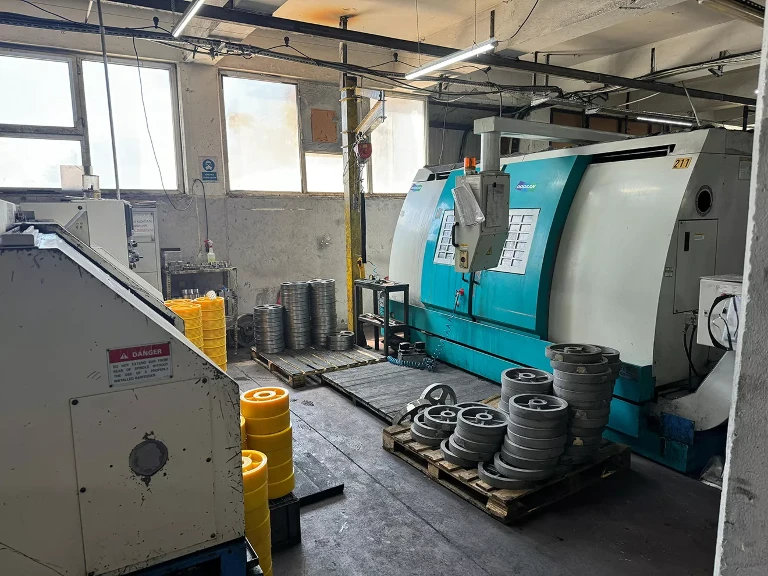
Indispensable Components of Safe and Efficient Motion Systems
Elevator systems are complex mechanical structures that ensure the safe transportation of people and loads. In these systems, another component that is as important as the motor, rope, car, and counterweight is the cast iron Pulleys. Particularly responsible for ensuring that the rope follows the correct route, changing its direction, and contributing to the balanced operation of the system, cast iron pulleys play a critical role in elevator performance and safety.
Unlike the main traction pulley, which directly performs the driving function, cast iron pulleys used in elevators are used as deflection pulleys, guide pulleys, counterweight pulleys, and auxiliary pulleys that ensure the rope moves in the correct position at different points of the system.
Manufactured from high-strength cast iron or ductile iron, these pulleys are designed to provide safe use for many years and are produced in accordance with international quality standards.
Function of Elevator Cast Iron Pulleys
In an elevator system, steel ropes move along a specific route. Cast iron pulleys are used at different points to ensure that the rope moves at the correct angle, remains at the appropriate tension, and is safely guided within the system.
These pulleys;
- Change the direction of the rope,
- Ensure that the rope moves along the designated axis,
- Prevent unnecessary friction on the rope,
- Maintain the mechanical balance of the system,
- Reduce vibrations that may occur during movement,
- Extend the service life of the rope
and perform important functions such as these.
A correctly designed and precisely machined cast iron Pulley ensures that the rope operates smoothly within the groove, thereby improving both safety and system efficiency.
Why Is Cast Material Preferred?
The material used in elevator pulleys is of great importance in terms of safety.
Cast materials;
are widely preferred in the elevator industry thanks to properties such as these.
Ductile iron materials, in particular, offer significant advantages in heavy-duty applications thanks to their high tensile strength and toughness.
Types of Cast Iron Pulleys Used in Elevators
Deflection Pulleys
Deflection pulleys are used to change the direction of rope movement.
They can be installed at different points in the machine room or inside the shaft.
Their functions are;
- ensuring that the rope moves at the correct angle,
- facilitating system layout,
- keeping rope movement under control.
Thanks to correctly machined groove geometry, they prevent unnecessary wear on the rope.
Guide Pulleys
These are auxiliary pulleys that ensure the rope moves along the designated axis.
They play an important role in organizing the rope route, particularly in high-rise buildings.
Thanks to these pulleys;
- rope deviations are prevented,
- the system operates more evenly,
- the vibration level is reduced.
Counterweight Pulleys
In some elevator systems, pulleys used on the counterweight side contribute to system balance by ensuring that the rope is correctly positioned.
These components, which operate continuously under load, must have high durability.
Tensioning System Pulleys
In some elevator applications, pulleys are used to help rope or governor systems operate at the appropriate tension.
The smooth rotation and low-friction operation of these pulleys are important for system safety.
Technical Specifications of Elevator Cast Iron Pulleys
The main features that a high-quality cast iron Pulley should have are as follows:
These features both extend the service life of the rope and improve system reliability.
Cast Iron Pulley Manufacturing Process
The production of pulleys used in the elevator industry is not limited to the casting process alone.
The manufacturing process generally consists of the following stages:
Each of these processes directly affects the safety and performance of the product.
What Should Be Considered When Selecting a Cast Iron Pulley?
Selecting the wrong pulley can lead not only to performance loss but also to accelerated rope wear and increased maintenance costs.
The main criteria to consider when selecting a pulley are as follows:
- Groove geometry suitable for the rope diameter
- Pulley diameter
- Load capacity
- Type of bearing to be used
- Shaft connection dimensions
- Rotational speed
- Material quality
- Machining precision
- Balance quality
The manufacturer's quality control processes and product traceability also play an important role in the selection.
The Importance of Regular Maintenance
Although cast iron pulleys used in elevators are long-lasting components, they must be inspected at regular intervals.
During maintenance;
must be inspected.
Periodic inspections help prevent unexpected failures and maintain system safety.
Contribution of Cast Iron Pulleys to Elevator Performance
High-quality cast iron pulleys are not merely mechanical parts; they are important components that affect the performance of the entire elevator system.
With a correctly designed pulley;
Cast iron pulleys used in elevator systems are critical machine elements that ensure the rope is correctly guided and contribute to the safe, quiet, and efficient operation of the system. It is of great importance that these pulleys, used for different functions such as deflection, guidance, counterweight, and tensioning, are manufactured from the correct material, precisely machined, and inspected regularly.
Selecting high-quality cast iron pulleys contributes to extending rope service life, reducing maintenance costs, and enabling the elevator system to provide safe service for many years. Therefore, choosing only cast iron pulleys that comply with standards, have undergone precise manufacturing processes, and have completed quality inspections is an important investment in terms of both safety and long-term operational efficiency.