The History of Elevators: A Journey from Antiquity to Modern Skyscrapers
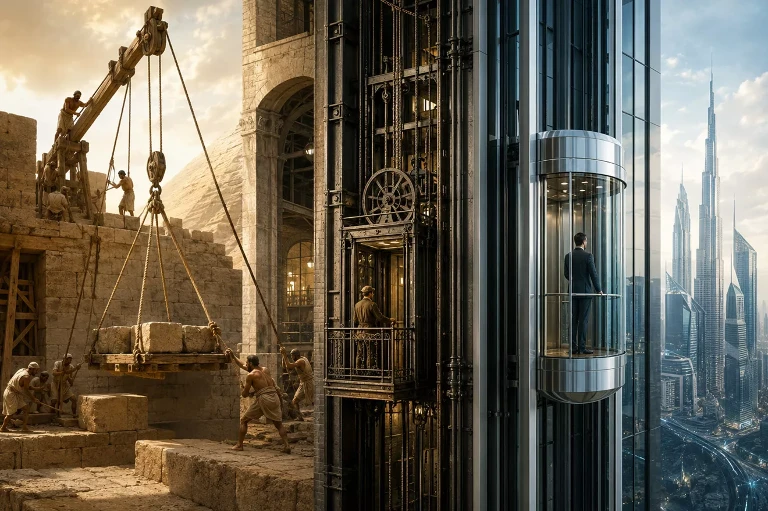
Today, elevators have become an indispensable part of life, from residential buildings and hospitals to shopping centers and industrial facilities.
Especially with the widespread construction of high-rise buildings, elevator systems providing safe, fast, and comfortable vertical transportation have become one of the fundamental elements of modern urban life.
However, the advanced elevator technology we use today is the result of thousands of years of engineering development. This process, extending from primitive lifting systems powered by human strength to AI-powered smart elevators, is one of the most remarkable development stories in the history of engineering.
The First Lifting Systems
The foundation of elevators lies in primitive lifting mechanisms developed to transport loads upward.
Historians state that the first lifting devices were used around the 3rd century BC. The ancient Greek mathematician and inventor Archimedes made significant contributions to the development of this technology through his work on pulley systems and lifting mechanisms.
The systems used during this period;
- Ropes
- Wooden pulleys
- Human power
- Animal power
were operated with the help of these and particularly facilitated the transportation of heavy loads at construction sites, in mines, and in warehouses.
Although these systems were not elevators in the modern sense, they are considered the first examples of vertical transportation.
Lifting Platforms in the Roman Period
Lifting systems developed further during the ancient Roman period.
Various platform systems were used in amphitheaters to raise stage decorations, bring gladiators into the arena, and lift heavy construction materials.
It is known that lifting platforms powered by human strength were used particularly in large structures such as the Colosseum.
These systems formed the foundation of elevator technology that would be developed in later centuries.
The Middle Ages and the Renaissance
Throughout the Middle Ages, lifting systems continued to be used particularly in castles, monasteries, and ports. For transporting loads;
- crane pulleys,
- rope systems,
- rotating drums
were widely used. During the Renaissance, safer lifting mechanisms began to be developed thanks to advances in engineering.
The Industrial Revolution and the Development of Elevator Technology
The Industrial Revolution, which began in the late 18th century, marked a significant turning point in elevator technology. With the development of steam engines, it became possible to transport heavy loads more quickly in factories.
The lifting systems used during this period;
began to be used extensively. However, these systems had a significant safety problem. If the rope broke, the platform would fall directly downward, resulting in serious accidents.
The Birth of the Safety Elevator
One of the most important developments in the history of modern elevators was the safety brake system developed by Elisha Otis in 1852.
The mechanism developed by Otis prevented the car from falling by locking it onto the rails if the hoisting rope broke.
During a demonstration at a fair held in New York in 1854, he asked for the rope to be cut while he was standing on the platform and attracted great attention by showing that the platform did not fall thanks to the safety system.
This innovation increased people's confidence in elevators and paved the way for the widespread adoption of modern passenger elevators.
The Emergence of Electric Elevators
As electric motors became widespread toward the end of the 19th century, elevator technology underwent a major transformation. The electric elevator developed by German inventor Werner von Siemens in 1880 offered a faster and more reliable operating system.
Thanks to the use of electric motors;
- taller buildings could be constructed,
- transport capacity increased,
- speed increased,
- maintenance became easier.
This development also radically changed urban architecture.
The Rise of Skyscrapers
With the development of steel-frame construction technology in the early 20th century, the construction of multi-story buildings accelerated. The most important technology that made these structures usable was modern elevators. Without elevator systems, it would not have been possible to use 20-, 30-, or 50-story buildings efficiently in daily life. Today, high-speed elevators operating in the world's tallest structures have reached the technology to travel kilometers per hour.
Elevator Technology Today
Modern elevator systems not only transport people but also prioritize energy efficiency, safety, and user comfort.
Technologies used today include;
These are among them. Thanks to these innovations, elevators operate more quietly, safely, and efficiently.
The Future of Elevators
As technology advances, the elevator industry continues to transform.
In the future;
- AI-powered traffic management,
- rope-free movement systems,
- magnetic propulsion technologies,
- fully autonomous maintenance systems,
- smart software that optimizes energy consumption
innovations such as these are expected to become more widespread. These developments will play an important role, particularly in smart city projects.
The history of elevators reflects humanity's desire to reach greater heights and transport heavy loads more safely. The process from the simple pulley systems of antiquity to today's high-speed and smart elevators is one of the impressive examples of progress in engineering and technology.
Today, elevators are not merely a means of transportation; they are advanced engineering systems that provide safety, comfort, and efficiency. With advancing technology, elevator systems offering more environmentally friendly, smarter, and safer solutions will continue to be an indispensable part of life in the cities of the future.